


 Log In
Big P.A.R.T.Y. encouraging Shaunavon-area students to make smart choices
Posted on October 19, 2026 by Ryan Dahlman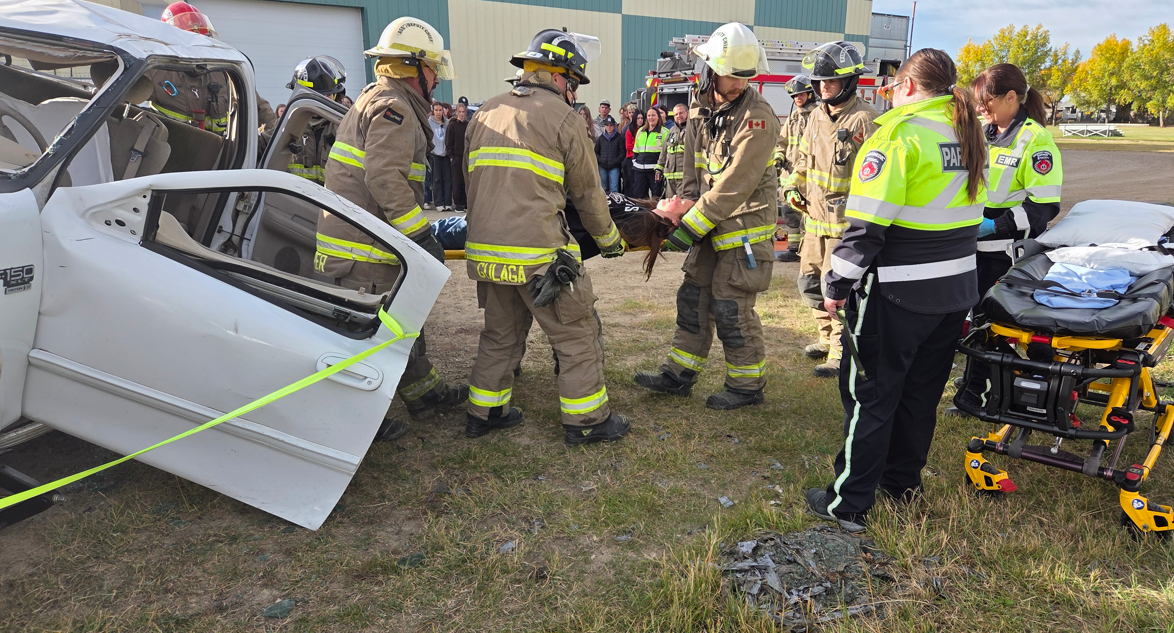
Shaunavon Standard
Grade 10 students from Shaunavon High School, Eastend School, and Frontier School received a first-hand look at the realities of a serious vehicle collision during the annual P.A.R.T.Y. (Prevent Alcohol and Risk-Related Trauma in Youth) program held recently at the LSB Legacy Wickenheiser Centre.
The initiative, which has operated in the community for two decades, aims to raise awareness among youth regarding the consequences of high-risk behaviour. This year’s mock scene involved a two-vehicle collision caused by a distracted driver. The simulation resulted in one simulated fatality, four injuries of varying severity, and the arrest of one driver.
Staged outdoors at the north end of the facility, the setup allowed students to observe how emergency responders – including local fire, ambulance, and RCMP crews – arrive at a scene and conduct their work.
Students also received instruction on how to respond safely if they encounter an emergency situation in the future.
Organizers used staged vehicles, makeup, and simulated distress to make the scene as realistic as possible, emphasizing that victims in such incidents are often peers and classmates. Local firefighters, EMS personnel, healthcare professionals, RCMP, and the local coroner all participated in the event.
Following the outdoor demonstration, students broke into smaller groups to follow the path of an injured patient, tracking their progression through medical care, rehabilitation, and a visit to a funeral home. At lunch, students participated in an exercise where they were assigned specific physical disabilities to simulate the challenges of eating with permanent injuries. The afternoon sessions featured presentations from RCMP, rehabilitation specialists, and addiction professionals, with support from high school staff and the School Community Council.
A key focus of the afternoon was shifting how youth perceive these traumatic events. A Saskatchewan Health official challenged the students to reframe how they speak about injuries.
“Injuries are not accidents,” the official stated. “If you think serious injuries just happen, have a word with yourself. Injuries are predictable and preventable. 90% of injuries are predictable and preventable.”
The presentation emphasized that changing terminology is a crucial step toward safety.
“When we think or refer to these preventable incidents as accidents, it gives us and others the impression that injuries can’t be stopped, that they are just an act of fate and always inevitable,” the official explained. “These are collisions, crashes, incidents, or mishaps, but rarely are they accidents.”
To prevent these crashes, students were urged to identify their own “stupid line,” or the choices that separates a smart risk from a stupid one. Officials warned that this boundary changes based on circumstances, experience, and environment, and is heavily blurred by alcohol, drugs, and peer pressure.
“Presence of peers more than doubles the number of risks,” the official noted, inviting students to define their personal limits.
To stay safe, the presentation outlined core “smart risk” strategies such as checking situations and understanding the risks, driving sober, wearing protective gear where appropriate, getting the proper training for certain endeavors, and getting help and support where needed.
The event concluded with a presentation from injury survivor Chelsea, who shared her personal experience following an alcohol-related rollover crash a decade ago. The collision killed two of her friends and left Chelsea in a coma for weeks. Following months of hospitalization and years of physical therapy, she said she is still continuing to recover from injuries ten years later.
Before heading home, students were challenged to take these lessons back to their communities.
“Reflect on what you’ve seen and heard here today. Make changes in your own life. Encourage friends to make changes, and bring this information to the community,” the health official concluded, noting that grant money is available through SGI (Saskatchewan Government Insurance) for student-led safety projects. “By participating in events like you did today, you’ve taken a step in your community to changing the language and how we view these incidents.”
Leave a Reply
You must be logged in to post a comment.